
How CopilotKit Is Redefining the Agentic AI Stack in 2026
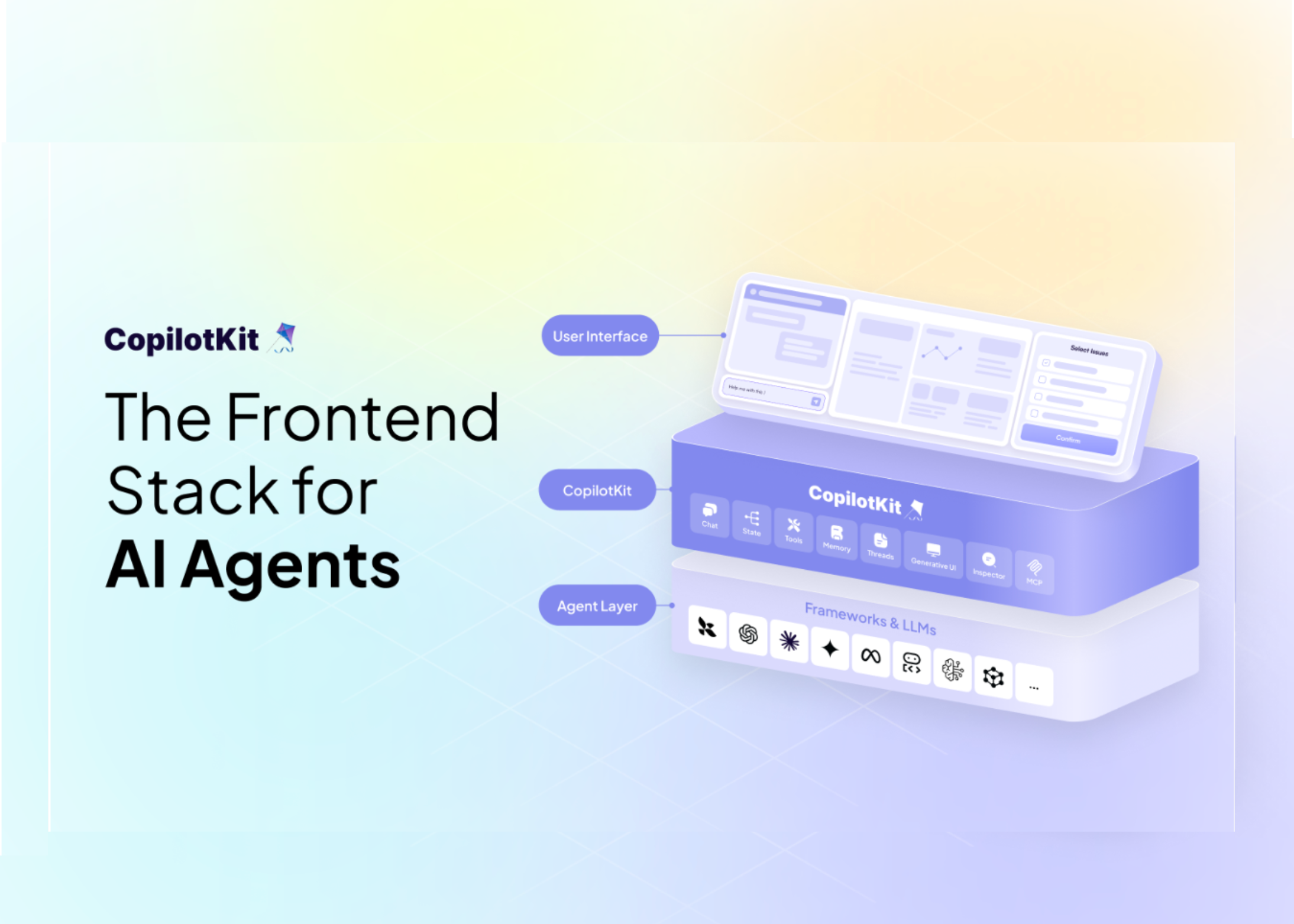


For years, AI inside software meant a chat widget bolted onto the corner of an application. You typed, the model responded with text, and you manually translated that output into whatever you actually needed it to do. It was useful the way a calculator is useful: functional, but fundamentally passive. CopilotKit, a Seattle-based startup co-founded by Atai Barkai and Uli Barkai, has spent the last two years arguing that the model is broken — and in 2026, the developer community is agreeing loudly.
Give CopilotKit a ⭐️ on GitHub
The company’s approach is straightforward: the way forward is to enable agents to live inside applications, understand what users are doing, take actions, and show useful interfaces instead of just returning long blocks of text. That approach has produced a sharp 2026 shipping cycle covering three distinct infrastructure gaps, knowledge retrieval, testing reliability, and runtime persistence with each release targeting the unglamorous, often-skipped architecture that separates agent demos from production-grade systems.
The Protocol Foundation: AG-UI Fills the Missing Slot
Before the new tooling makes sense, the protocol layer underneath it needs to. The agentic ecosystem has quietly assembled a three-layer stack. MCP standardizes how agents access external tools and databases. A2A handles coordination between agents. AG-UI, created by CopilotKit, handles the third and previously unaddressed problem: the interaction layer between agents and human users inside software applications.
While MCP and A2A handle context and agent coordination, AG-UI defines the layer of interaction between the user, the application, and the agent, providing transparency, safety, and control at the most critical boundary, where users interact with agents. Concretely, it enables real-time streaming responses, dynamic UI component generation, bidirectional state synchronization, and human-in-the-loop pauses where agents wait for user confirmation before proceeding.

The protocol is today supported by major AI infrastructure providers like Google, Microsoft, Amazon, and Oracle, as well as popular frameworks including LangChain, Mastra, PydanticAI, and Agno. First-party SDKs cover LangGraph, CrewAI, Mastra, Agno, and Pydantic AI. On the community side, fully supported implementations now exist for Kotlin, Go, Dart, Java, Rust, Ruby, and C++, with .NET, Nim, Flowise, and Langflow currently in progress — a community SDK surface that goes well beyond what most protocols at this stage can claim. AWS has integrated AG-UI into its FAST (Fullstack AgentCore Solution Template) examples and Bedrock AgentCore, cementing its role as production infrastructure rather than an experimental standard. The ecosystem has also expanded into education: Atai Barkai teaches a full-stack AG-UI course on DeepLearning.AI, covering a LangChain backend, React frontend, and AG-UI as the runtime — a tangible signal that the protocol is mature enough to be taught, not just evaluated.
The framing that once pitted MCP against A2A against AG-UI has given way to a recognition that these protocols solve fundamentally different problems — analogous to how TCP, HTTP, and HTML operate at different layers of the web. AG-UI is the HTML of that stack: the presentation and interaction layer that the lower layers make possible but cannot themselves provide.
AIMock: Your Test Suite Was a Lie

Released in April 2026, AIMock is the most direct manifestation of CopilotKit’s willingness to ship tools that expose uncomfortable truths about how most teams are building. The uncomfortable truth here is that agentic test suites are mostly theater. A single agent request in 2026 can touch six or seven services before returning a response: the LLM, an MCP tool server, a vector database, a reranker, a web search API, a moderation layer, and a sub-agent over A2A. Most teams mock one of them. The other six are live, non-deterministic, and quietly making the test suite a lie.
AIMock is the fix. One JSON config file. One port. Every service your AI app depends on. The tool covers eleven LLM providers — including OpenAI, Claude, Gemini, Bedrock, Azure, Vertex AI, Ollama, and Cohere — alongside full MCP JSON-RPC 2.0, A2A agent card discovery and SSE streaming, AG-UI event stream mocking for frontend testing, vector database simulation for deterministic RAG retrieval (Pinecone, Qdrant, ChromaDB compatible), and search, rerank, and moderation endpoints. Zero dependencies — everything built from Node.js builtins.
Three capabilities separate it from every prior mocking tool in this space. Record-and-replay proxies real API calls, saves them as fixtures, and replays them in CI forever without touching live APIs again. Drift detection runs daily against real provider APIs and catches response format changes within 24 hours, before users encounter them — because LLM providers regularly update their schemas without notice. Chaos testing lets developers inject 500 errors, malformed JSON, and mid-stream disconnects to verify their application handles failures gracefully rather than discovering that edge case in production.
AG-UI itself uses AIMock for its own end-to-end test suite, verifying agent behavior across LLM providers with fixture-driven responses. When the protocol uses the tool to test itself, the self-referential signal is hard to dismiss.
Pathfinder: Agent-Native Knowledge Infrastructure

The third pillar of the 2026 cycle addresses how agents find accurate, current information about the software and documentation they are supposed to work with — a problem that rarely surfaces in demos but consistently blocks production deployments.
Pathfinder is a self-hosted MCP server that indexes docs, code, Notion pages, Slack threads, and Discord forums into searchable, agent-accessible knowledge via MCP — one config file, one command, compatible with any AI coding agent. GitHub repositories are ingested at the document level — Markdown, MDX, HTML, and source code — while conversational sources like Slack and Discord are distilled into searchable question-and-answer pairs that surface institutional knowledge usually trapped in chat history.
The search architecture combines hybrid vector and keyword retrieval, which matters in practice because pure semantic search fails on exact identifiers, error codes, and API names that appear verbatim in queries. Pluggable embeddings support OpenAI, Ollama, and local transformers.js, meaning fully air-gapped deployments that require no external API key are a first-class option rather than an afterthought.
Configuration lives entirely in a single pathfinder.yaml file. GitHub push events trigger incremental reindexing through webhook integration. Auto-generated endpoints — /llms.txt, /llms-full.txt, and /.well-known/skills/default/skill.md — give agents and clients standard discovery paths without additional configuration. CopilotKit runs Pathfinder for its own public documentation, accessible at mcp.pathfinder.copilotkit.dev, making it a live proof-of-concept rather than a reference architecture.
The self-hosted privacy model is explicit: self-hosted Pathfinder sends nothing externally. Telemetry is gated on a CopilotKit-internal environment variable that is not set in any publicly distributed image or package.
The Stack That Closes the Production Gap
The throughline across these three releases is not obvious from any single tool in isolation. Pathfinder addresses knowledge retrieval — agents need accurate, queryable context about the systems they operate within. AIMock addresses testing reliability — every service in the agentic call chain needs to be mockable, deterministic, and observable before shipping. CopilotKit Enterprise Intelligence, the persistence layer, addresses runtime memory — agents need to carry context across sessions and devices without engineering teams building that infrastructure from scratch.
Together, these three layers cover the production blockers that consistently turn promising agent prototypes into stalled engineering projects. CopilotKit’s tools see millions of installs per week, and a large portion of Fortune 500 companies are using the protocol and CopilotKit’s tools in production.
CopilotKit differentiates itself as a horizontal, vendor-neutral alternative that works with whatever agent framework, cloud provider, or backend a company already uses, competing with Vercel’s AI SDK, Assistant-ui, and OpenAI’s Apps SDK. The strategy is to own the app layer — the interaction boundary, the test layer, and the knowledge layer — without forcing teams to rebuild the rest of their stack around a proprietary runtime.
Marktechpost’s Visual Explainer
Key Takeaways
- AG-UI completes the agentic protocol stack by handling the agent-to-UI interaction layer that MCP and A2A leave unaddressed, with first-party SDKs across LangGraph, CrewAI, Mastra, Agno, and Pydantic AI, and community SDKs now live for Go, Kotlin, Dart, Java, Rust, Ruby, and C++.
- AIMock ships one zero-dependency mock server for the entire agentic call chain — 11 LLM providers, MCP, A2A, vector DBs, search — with record-and-replay, daily drift detection, and chaos testing built in.
- Pathfinder is a self-hosted MCP knowledge server that indexes docs, code, Notion pages, Slack, and Discord into hybrid vector-keyword search, with pluggable embeddings that need no external API key.
- The three tools together target the three production blockers — knowledge retrieval, testing reliability, and runtime persistence — that demo-quality agents consistently fail to address.
- CopilotKit’s vendor-neutral, self-hostable design means teams can adopt any single layer without being locked into a proprietary runtime or forced to rebuild their existing stack.
Note: Thanks to the Copilokit team for supporting us for this article. This article is sponsored by Copilotkit.


